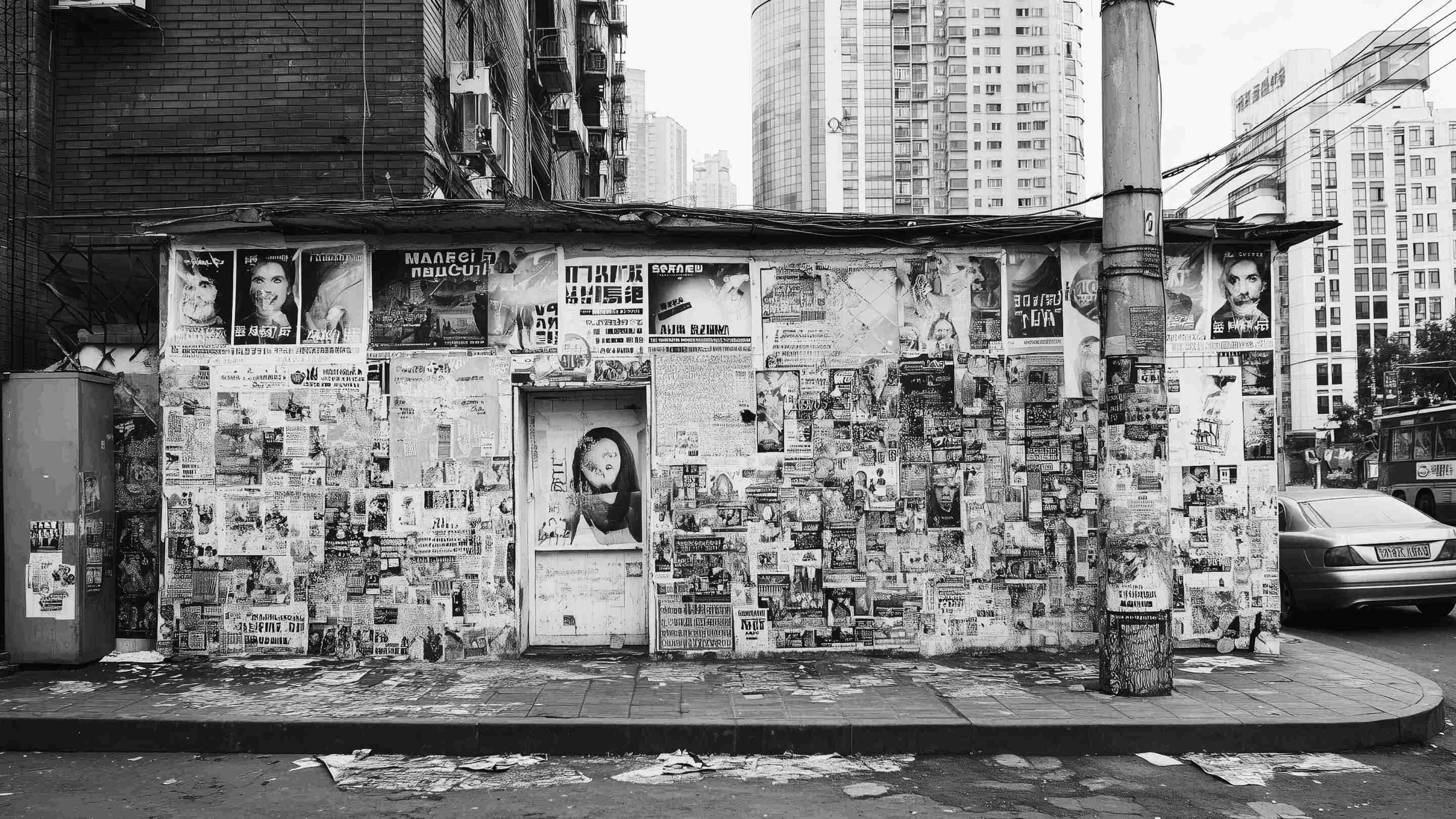
Posters demand decisions
Posters leave very little room for hesitation.
Unlike interfaces or long form layouts, posters ask for immediate clarity. They are seen quickly, often from a distance, and rarely in ideal conditions. Every decision must earn its place.
A poster does not explain itself. It either works or it disappears.
Posters are read with the eyes before they are read with the mind.
Start with one message
Most posters fail because they try to say too much.
A poster can carry multiple details, but it needs one primary message. One dominant idea that gives the viewer a reason to look again.
If you cannot describe the poster in one sentence, the design will usually feel scattered.
Hierarchy is not subtle
In poster design, hierarchy must be obvious.
There needs to be a clear entry point, a dominant element that pulls attention first. From there, the rest of the information should fall into place naturally.
If everything is loud, nothing is heard. If everything is quiet, nothing is seen.
A good poster often behaves like a strong headline with a clean supporting paragraph.
Design for distance first
Posters are rarely experienced up close.
People see them while walking, commuting, passing a doorway, turning a corner. The context is messy, lighting is inconsistent, and time is limited. This changes everything.
Type that feels large on screen may collapse on a wall. Thin strokes vanish. Subtle contrast fails. Fine texture becomes noise.
If it only works up close, it does not work.
A useful habit is to design from far to near. Get the big read working first, then refine.
Scale is the main tool
Posters are a medium of scale.
Scale is what creates impact, hierarchy, and rhythm. It is also what creates tension.
Oversized type can become image. Small type can become texture. A single huge word can do more than a full paragraph, if the composition supports it.
The strongest posters commit to scale early. They do not negotiate with it.
Use constraint to sharpen taste
Posters thrive on limitation.
Limited color palettes, restricted type choices, and simple layouts force stronger decisions. Instead of decorating, you begin composing. Instead of filling space, you shape it.
Constraint removes hesitation and sharpens intent.
Try setting rules like these:
One typeface, two weights
Two colors, one neutral
One grid, one break
When the system is tight, the poster can still feel expressive, but it stays coherent.
Composition is the difference
Posters live or die by composition.
Alignment, negative space, and balance are not finishing touches. They are the structure. A poster can be minimal and still feel loud if the composition is sharp.
Look for:
Clear margins
Intentional alignment
Deliberate imbalance
Controlled density
A poster should feel placed, not filled.
Make information secondary but clear
Most posters need details, dates, venue, lineup, website, but those details should not compete with the message.
The goal is a fast first read, then a clean second read.
Patterns that usually work:
Big idea at the top, details at the bottom
Big idea centered, details in a quiet column
Big idea as a block, details as a caption
Information should feel designed, not attached.
Think like a printer
A poster is not just an image. It is a physical object.
Paper texture, ink density, dot gain, and print methods all influence the final result. What looks perfect on a screen may feel flat in print.
Print constraints that matter early:
Minimum type size for the viewing distance
Ink coverage and contrast
Paper color and finish
Overprint and trapping if using spot colors
When print is considered from the start, the result feels intentional rather than accidental.
Print rewards commitment.
The poster is the message
The best posters do not try to explain everything.
They provoke curiosity, set a tone, or create a memory. Information can follow elsewhere. The poster’s role is to stop someone, even briefly.
A successful poster leaves an impression, not instructions.
Key ideas
Posters require immediate clarity
One message beats many messages
Distance changes the design
Scale is the main lever
Print context is part of the system